People of all skin tones, races, and ethnicities can develop psoriasis, however, that doesn't mean it looks the same on everyone. Unfortunately, there can be significant barriers for people of color to receive accurate diagnosis and treatment for their psoriatic disease. Because of this, there may be more people with skin of color living with psoriasis than is reported. NPF is here to help with resources, advice, and stories specifically for you to help you live the healthy and happy life that you deserve.
Skin of Color Resource Center

Frequently Asked Questions
Can people of different skin types get psoriasis?
People of all races and ethnicities can develop psoriasis. Psoriasis has been found more frequently among White individuals (3.6%) than in Asian individuals (2.5%), Hispanic individuals (1.9%), and African American individuals (1.5%). [1] This difference may be because psoriasis has been more easily identified in people with lighter skin and misidentified in people with darker skin types. [2] But there may be more people with skin of color living with psoriasis than is reported. African American and Hispanic/Latine patients may also experience greater impacts from psoriasis on their quality of life.
What does psoriasis look like on skin of color?
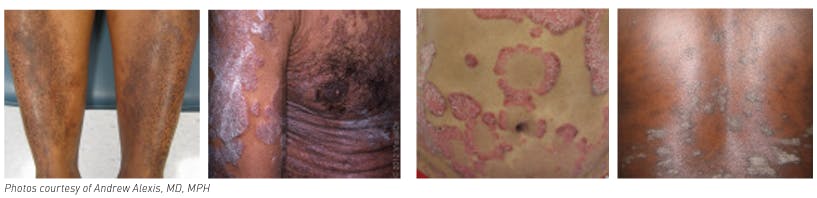
Psoriasis may look different on different skin types. On darker skin types, psoriasis may look salmon, dark brown, purple, or violet with grayish scale. [2,3] On lighter skin, psoriasis often looks red with a silvery scale on top. [2]
Here are more ways that psoriasis may look different on darker skin types [2]:
- Plaques may be thicker and have more scaling.
- Patients may have more body surface area (BSA) affected by psoriasis than patients with lighter skin.
- Patients may have more dyspigmentation (hypo and hyperpigmentation) and less redness (erythema).
It is important that health care providers look at more than the color of the affected skin when diagnosing psoriasis on skin of color. To make a diagnosis, your health care provider will look at your skin, nails, and scalp. They may also do a skin biopsy, which is when a small skin sample is removed and looked at under a microscope.
How can I get a correct diagnosis?
Since psoriasis can look like other skin conditions, on any color of skin, it is important to make sure you are getting a correct diagnosis. Psoriasis on darker skin may look like eczema, lichen planus, sarcoidosis, cutaneous T cell lymphoma, or even discoid lupus. Prurigo nodularis is another skin condition that may be mistaken for psoriasis.
To get a correct diagnosis, it is best to see a dermatologist. Also, it may help to see a dermatologist who has experience diagnosing psoriasis in people who have the same skin color as you. If you feel that you are not getting a correct diagnosis, you can get a second opinion from another provider.
Visit the Health Care Provider Directory to find providers who are experienced in treating psoriasis and patients of all skin colors.
What are the considerations for treatment in skin of color
Although skin affected with psoriasis may look different depending on your skin color, the treatment options are the same. However, there are two important factors to discuss with your health care provider when it comes to treatment if you have darker skin.
- UV (ultraviolet) radiation used in phototherapy (also called light therapy) may make the skin temporarily darker. Talk with your provider if you are concerned about this side effect. The amount of light needed for treatment may also differ with darker skin types.
- If you have scalp psoriasis, talk with your provider about treatments that would work for your hair type and how frequently you wash your hair. Some medicated shampoos require daily use, which can cause dryness and breakage in patients with coarser hair texture. Ask your provider if you can get your topical treatment in a different form, such as an oil, lotion, foam, or other solution. This can help increase the likelihood of sticking with your treatment plan.
Some traditional cultural therapies or practices may cause psoriasis to worsen from the Koebner phenomenon. The Koebner phenomenon occurs when new psoriasis plaques appear on previously healthy skin where an injury to the skin occurs. Traditional Asian healing practices, such as cupping, coining, and moxibustion, can lead to the Koebner phenomenon. Scalp scratching, which is practiced by some members of African American communities, can also cause the Koebner phenomenon.
Visit the Health Care Provider Directory to find providers who are experienced treating psoriasis and patients with all skin colors.
Stories

Representation, Inclusion, and Shared Experiences
An NPF focus group provides their insights into advocating for yourself as a Person of Color with psoriatic disease.
Read more

Meet Rajesh Khanal
How three different nations and health care systems created a unique and challenging journey for this new father.
Read Rajesh's story

Ayesha’s Story
Black Girls, Blue Magic & Black Girl Magic
Read Ayesha's story
.jpg?ixlib=gatsbyFP&auto=compress%2Cformat&fit=max&rect=0%2C47%2C835%2C539&w=310&h=200)
Treating Skin of Color
For some psoriasis patients, getting the right diagnosis isn’t always so black and white. And once minorities receive the proper diagnosis, they often face unique risks, challenges, and stigmas.
Read more

Volunteer Spotlight: Shubana Mohammad
Growing up with psoriasis and psoriatic arthritis inspired Shubana Mohammad to give back through volunteering.
Read Shubana's story

No, It’s Not Contagious
A Dominican-American man with psoriasis fends off the usual annoying questions, battles his anger, searches for the right treatment, and helps raise awareness.
Read Edgar's story
.png?ixlib=gatsbyFP&auto=compress%2Cformat&fit=max&rect=19%2C0%2C1046%2C675&w=310&h=200)
Fashion Forward
As a fashion lover with psoriasis, Alisha Bridges knows that looking great and feeling comfortable in the latest styles is completely possible.
Read Alisha's tips
Resources
.png?ixlib=gatsbyFP&auto=format%2Ccompress&fit=max&rect=530%2C0%2C388%2C250&w=310&h=200)
Downloadable Resources

Plaque Psoriasis in Skin of Color
Patient advocate Alisha Bridges and dermatologist Dr. Mona Shahriari discuss a study dedicated to people of all skin tones.
Listen to the episode

Why Is Psoriasis Often Misdiagnosed in Skin of Color?
Too often people with darker skin tones struggle for an accurate diagnosis compared with those with fair skin.
Read more
.png?ixlib=gatsbyFP&auto=compress%2Cformat&fit=max&rect=83%2C0%2C1116%2C720&w=310&h=200)
Webinar: Psoriasis and Skin of Color
Hear Dr. Tiffany Mayo present features of psoriasis in skin of color, challenges that impact diagnosis, treatment choices, and tips for caring for skin of color with psoriasis.
Watch now

How Health Disparity Affects Health Care
Those with skin of color living with psoriatic disease see disparities in health care, disease burden, and representation.
Read more

Equal Access to Care
If you are living with psoriasis and reside in an area with limited or no access to a dermatologist, there are a few ways you can access care.
Read more

Cutting Hair with Kindness
The GHLF salon HEROES program brings education and empathy for those living with psoriasis, eczema, or alopecia, especially in communities of color.
Read more
Skin Care E-Kit
Request your Skin Care E-Kit to learn how to understand your skin and maintain skin health – includes the Psoriatic Disease and Skin of Color Quick Guide!

Traducciones al español | Spanish Translations
¿Buscas información en español? Haz clic en el enlace de abajo y selecciona "Español" como tema.
Looking for information in Spanish? Click the link below and choose "Español" as the Topic.
References
[1] Armstrong AW, Mehta MD, Schupp CW, Gondo GC, Bell SJ, Griffiths CEM. Psoriasis Prevalence in Adults in the United States [published online ahead of print, 2021 Jun 30]. JAMA Dermatol. 2021;e212007. doi:10.1001/jamadermatol.2021.2007
[2] Kaufman BP, Alexis AF. Psoriasis in Skin of Color: Insights into the Epidemiology, Clinical Presentation, Genetics, Quality-of-Life Impact, and Treatment of Psoriasis in Non-White Racial/Ethnic Groups [published correction appears in Am J Clin Dermatol. 2018 Feb 16;:]. Am J Clin Dermatol. 2018;19(3):405-423. doi:10.1007/s40257-017-0332-7
[3] Can You Get Psoriasis if You Have Skin of Color? AAD.org. https://www.aad.org/public/diseases/psoriasis/treatment/could-have/skin-color. Accessed April 26, 2021.
Last updated on 12/30/25 by the National Psoriasis Foundation.