The good news is that with the right treatment and help from your health care provider, you and your family can successfully manage this disease. Let’s dive into your questions.
For Teens: What is Psoriasis?
If you have just learned you have psoriasis, you probably have lots of questions. What is it? Why me? Is it permanent? What does this mean for my life? What can I do about it?

What is psoriasis?
- Psoriasis (sore-Eye-ah-sis) occurs when skin cells grow too quickly, building up on the skin and causing red, pink, purple, or brown (depending on your skin tone) plaques or lesions.
- Normally, it takes 21-28 days for cells on the surface of the skin to grow and shed. In psoriasis plaques, it takes skin cells 3 to 4 days to grow. Given how quickly the skin cells grow, they do not shed as quickly. This causes the skin cells to build up, which forms the plaques or lesions on your skin.
You are not responsible for developing psoriasis. You did not do anything for psoriasis to occur.
Is psoriasis contagious?
No! It’s important to know that no one can catch psoriasis from you. People may be afraid when they see your skin, but let them know what psoriasis is and that it is not a contagious disease.
What are the symptoms of psoriasis?
- Psoriasis can cause itching and pain with silvery scale or plaques, which are typically raised, thick skin. It’s possible your psoriasis plaques may look different than those of adults. The scales or patches could be thinner, smaller, and softer.
- Irritation, burning, or stinging.
- Dry skin that may crack or bleed.
- Flaking of dead skin.
What type(s) of psoriasis do I have?
Check with your doctor regarding what type of psoriasis you have and what treatment options work best for you. Be aware that no one treatment works the same for everyone. It may take time to find the right treatment, dose, and management routine.
There are 5 types of psoriasis.
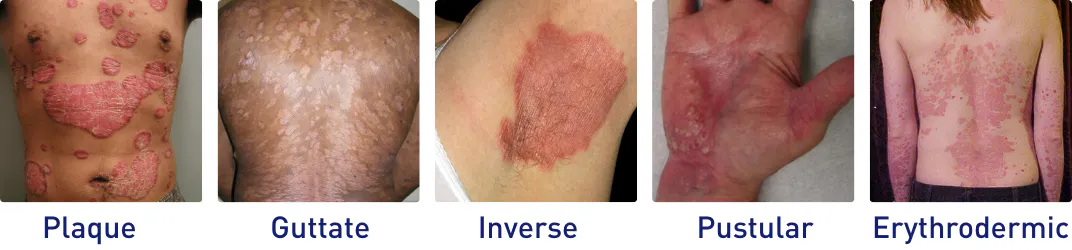
- Plaque psoriasis is the most common form of psoriasis, appearing as raised, inflamed, red, pink, violet, or brown plaques covered by silvery white scales.
- Guttate psoriasis often starts at an early age, from childhood to young adulthood, and appears as a large number of small, round, and scaly red to brown spots on the arms, legs, and torso. Sudden flares can be triggered by an infection like strep throat.
- Inverse psoriasis or intertriginous [in-ter-TRIJ-i-nus] psoriasis appears as pink to deep red to brown skin that is smooth and not scaly, affecting the skin folds like the underarms, genital area, and buttocks.
- Pustular [PUS-choo-ler] psoriasis includes pustules (white, pus-filled, painful bumps) in addition to the inflamed, red or darkened skin. This type of psoriasis may affect large areas of the body, as in general pustular psoriasis, or the palms of the hands or soles of the feet, as in palmoplantar pustular psoriasis.
- Erythrodermic [eh-REETH-ro-der-mik] psoriasis can cause intense redness and shedding of the skin, severe itching and pain, changes in heart rate and temperature. If you have such symptoms, it is important to seek immediate medical attention during an erythrodermic flare.
It’s possible to have more than one type of psoriasis. For example, plaque and guttate psoriasis can appear together. Psoriasis tends to come and go with flares. During a flare of the disease, there could be more psoriasis plaques or lesions. When treatment is working well, there will be fewer or no plaques.
Where can psoriasis appear?
Places where psoriasis can develop include:
- Creases of the elbows and back of the knees
- On the chest and back
- In skin folds such as the underarms, under the breasts, in the genital area* or buttocks
- The face*, ears, and scalp* which is a typical location for psoriasis to begin
- On the feet*
- On the hands* and nails*
*These areas are considered to be high-impact areas, meaning they may have more impact on day-to-day activities and be harder to treat.
The amount of skin affected by psoriasis can change over time and flare in more than one area, ranging from a few small patches to larger areas.
Why do I have psoriasis?
It’s not clear why psoriasis develops. We know psoriasis is an immune-mediated disease, meaning the immune system is not functioning correctly and is overactive, which causes inflammation in the body. That inflammation could be caused by:
- Genetics: Sometimes psoriasis develops due to genes you inherit from family members. You can also be the only person in your family who develops psoriasis.
- Immune system: Psoriasis may be triggered by an illness or infection such as strep throat, which is common in youth.
- Environment: Other potential triggers include emotional or physical stress, injury to the skin such as cuts, scratches, bug bites, or sunburns, and hormonal changes.
Triggers for psoriasis flares are different for each person. What triggers your psoriasis may not be the same for someone else.
“If someone asks me, I mainly tell them what it is, how it’s a skin condition that is noncontagious, and I tell them everything that I know about it so they stay informed. If they meet someone else with psoriasis, they'll know more about it and won't say anything that could make anyone feel bad about it.”
– Zack H., 14, lives with psoriasis
Will my skin always look this way?
No! With the right treatment, your psoriasis lesions or plaques will improve. Work with your health care provider to find the best treatment plan for you. It may take time and perhaps a combination of treatments, but with today’s treatments, it is possible to achieve close to clear or fully clear skin.
What does psoriasis mean for my life?
- Psoriasis is not something to be scared of. You can have control over what you do with the right treatment plan and precautions.
- Work with your health care provider(s) to treat your psoriasis and live a healthy lifestyle to reduce the inflammation and risk of related conditions like heart disease, psoriatic arthritis, depression, anxiety, or type 2 diabetes.
- Psoriasis is a chronic or lifelong systemic disease. With the help of your health care providers and treatment, you can live a long and full life.
“Understand what you have on your body so that you have a better idea of what the dermatologists are telling you. You can also tell people who are less informed than you what you have and why you feel this way. Knowing what you have and staying on top of your medicine makes it so much better because it gives you more control over your body. Now that I understand what psoriasis is, that's helped me so much.”
– Saanvi G., 15, lives with psoriasis
What Can I Do?
Who can help me with psoriasis?
The following are typically part of your health care team:
- Your family doctor or pediatrician: When symptoms first appear, you may see your family doctor or pediatrician to discuss your symptoms and possible treatment. They may also provide a referral for you to see a dermatologist.
- A dermatologist is a specialist in diseases of the skin, scalp, hair, and nails who can help you and your parents identify a treatment plan to improve your psoriasis symptoms and make adjustments as you grow older. Psoriasis is best diagnosed and treated by a dermatologist.
- Other specialists may be added to help you manage issues, such as if you develop joint pain, you would see a rheumatologist, or if you need help with depression or anxiety, you would see a mental health counselor.
If you need help finding a dermatologist or rheumatologist, you can search the Health Care Provider Directory or contact the Patient Navigation Center.
What can be used to treat psoriasis?
There are many effective medications available to treat psoriasis, and the good news is that options continue to become available. Work with your pediatrician or dermatologist to identify the right treatment plan for you. It may take time to find the right treatment, as not all medications work the same. You may need to try several medications before you find what works best for you. Options include:
- Topicals, either over-the-counter or prescription, work to slow down excessive skin cell growth, reduce skin inflammation, and moisturize the skin. Topicals come in different forms like lotions, foams, bath solutions, shampoos, and ointments.
- Phototherapy or light therapy exposes the skin with psoriasis to ultraviolet light on a regular, consistent basis as prescribed by your dermatologist. This can be a successful method for treating psoriasis, done either in a health care provider’s office or at home.
Note: Tanning beds and sun lamps are not recommended as a substitute for UVB light since they use a different type of light and are not done under a health care provider's supervision. - Pills or oral systemic medications are taken by mouth and prescribed when topicals or phototherapy are not enough to clear your psoriasis or when joints are affected by psoriatic arthritis.
- Biologics and biosimilars are treatments that target specific parts of the immune system and are given by injection or IV infusion (delivering medication directly into a vein). Biologics are used to treat the skin and joints and can be used with other treatments if needed.
It may take time and possibly a combination of treatments to clear your psoriasis plaques. Talk with your doctor about your goals of treatment and when to expect clearance.
What else can I do?
Just like it is important to treat your psoriasis, it is also important to take care of your whole body. Things you can do include:
- See your primary care provider at least once a year to stay on top of general health screenings.
- Prepare for your doctor appointments by identifying the 3 most important questions you would like answers to, which will help make your limited time more effective.
- Eat right and be active. Some foods that you eat may promote inflammation in your body. Choose to eat more fruits, vegetables, whole grains, olive oil, fish, and other lean meats, as well as eat less sugar, caffeine, and processed foods.
- Get enough sleep. Lack of sleep can increase the risk of developing anxiety, depression, and stress, along with impacting your ability to focus. It can also weaken the immune system. It is recommended that teens receive 8 to 10 hours of sleep per day. [1]
- The facts – alcohol, smoking, or vaping increase the risk of developing psoriasis and inflammation, leading to increased severity of the disease. Such use can also make psoriasis more difficult to treat. Use of other non-prescription treatments such as cannabis (i.e., weed/marijuana) can worsen anxiety and depression, lead to weight gain, type 2 diabetes, high blood pressure, and heart disease – all of which are at higher risk with psoriasis. It is also possible that weed could cause interactions with current medications by amplifying side effects of those medications.
- If you have issues with anxiety or depression, talk with your health care provider about a referral to a mental health counselor. Don’t suffer in silence when you need help.
- Stay connected to others in your community or find other groups that offer a sense of understanding, such as the NPF’s Youth Ambassador Program.
- Access resources if you need help. Contact the Patient Navigation Center if you need help finding a dermatologist.
- For more information, explore our Psoriatic Disease Resources Library to download a topic of interest.
“Staying informed, finding resources like NPF, and finding a community, I really think that's important. Knowing that other people are experiencing the same thing and being able to confide in somebody when you feel like you're alone really helps. Don't struggle in silence, because there's always a community out there.”
– Brianna P., 20, lives with psoriasis
Hopefully you feel more at ease with your diagnosis of psoriasis and realize you can live with psoriasis. You are not alone. Work with your health care provider and access resources to help learn more about living with psoriasis.
Additional Resources

Patient Navigation Center
Contact the Patient Navigation Center for more information or if you need help finding a specialist in your area.
Get in touch

Stories for Teens and Young Adults
Discover stories from teens and young adults about managing life with psoriasis and psoriatic arthritis.
Read their stories

Become a Youth Ambassador
Meet others who understand and develop friendships with other youth with psoriasis and psoriatic arthritis. Serve as a leader in our community.
Learn more
References
- “Recommended Amount of Sleep for Pediatric Populations: A Consensus Statement of the American Academy of Sleep Medicine” https://aasm.org/resources/pdf/pediatricsleepdurationconsensus.pdf
This program is supported by the Centers for Disease Control and Prevention of the U.S. Department of Health and Human Services (HHS) as part of a financial assistance award totaling $351,404, with 2 percentage funded by CDC/HHS and $14.3 million amount and 98 percentage funded by non-government source(s). The contents are those of the author(s) and do not necessarily represent the official views of, nor an endorsement, by CDC/HHS, or the U.S. Government.